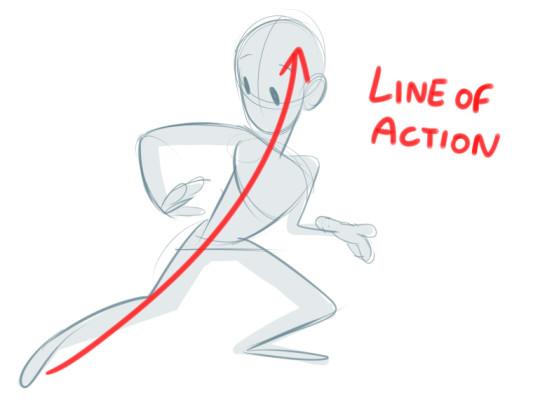
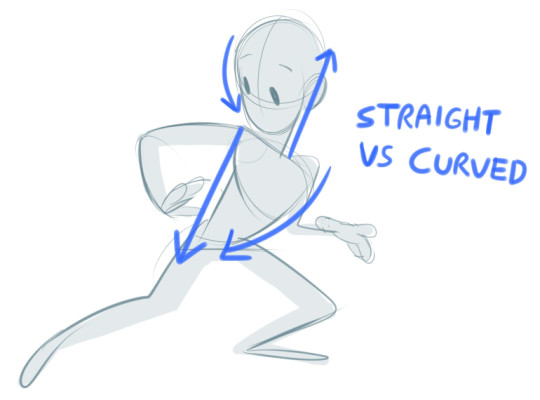
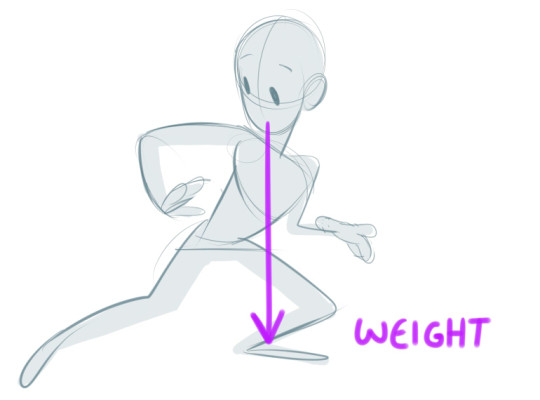
I guess three things I think of when it comes to poses are line of action, straight vs curved, and weight. I’ll use this quick awkward doodle to demonstrate:
You probably know this one if you know animation. Everything in the drawing doesn’t necessarily have to stick to it, but its a good basis for the overall silhouette. Most examples I’ve seen stick to one line, but sometimes I experiment with two if I’m going for a more action-y, dynamic pose. Its best not to go over two (two is risking it) as that would just get too visually confusing.
This one is more for smaller details, such as the arms and legs. Its good if you want to go for a more stylized look, since real life humans never have completely straight lines anywhere on their body. It’s basically contrasting a straight line with a curved one so you get a clearer idea of where the volume is going. Check out this video if you want more info, which is where I referenced from!
An easy one to forget in my experience. A little trick we learnt in life drawing class is that in real life the nose should generally be parallel to where the most weight is, to make it look more balanced. You’ll notice too that the body gets more compressed where the most weight is, ie the left leg here.
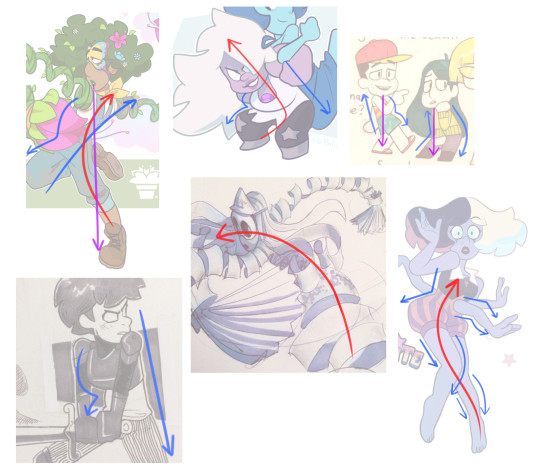
Some of my own (colour coded) examples, although I’m still learning to apply these things ~
(Sometimes if the nose doesn’t line up with where the body is leaning, you have to balance it out with the limbs or other body parts. The amethyst one would not work if she wasn’t holding another character on her back)
I recommend looking up these techniques online or in art books as you’re bound to find more in-depth tutorials and examples. But overall I hope this helps!
Here’s a very sloppy like crash course about expressions that doesn’t even really cover it all. Practicing is the first big step, and research is a good definite baseline.
Look up expressions by real people, use a mirror and play around with narrowing your eye brows, making your mouth do funny things, look at how your nose crinkles and where else on your face wrinkles (like the forehead and the nose to mouth).
reblog! you don’t need to reblog to your main blog, you can make a sideblog just for art reblogs! if you want you can post fanart even if you’re not in the fandom!
follow #My Art! it’s a really great way to find all kinds of new artists!!
leave a nice comment! message them! send an ask! off anon is better! it’s pure f u e l for creative people!
commission them or support them on whatever website they use if you can! reblogging their commission info posts also helps a lot!
DRAW THEIR OC’S oh my goodness, it would make their whole week
– One of the biggest fears writers face is burnout, or “writer’s block”. However, there’s always a way to look at the positives in a situation. Please take the following to heart: Not actively creating is okay, as long as you continue to your goals in another way.
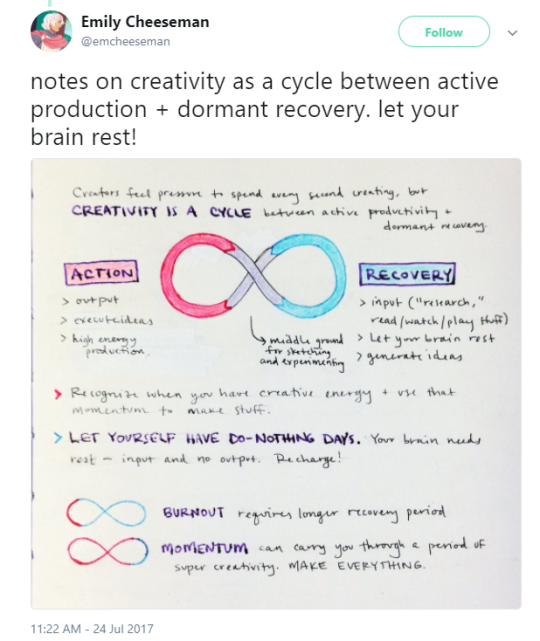
Do not ever beat yourself up over not having the momentum to keep creating actively, 24/7. You need days where you relax and research and find inspiration. It’s not laziness. It’s an important part of the creative process. There’s a fabulous visual by emcheeseman on Twitter that was made for artists and explains this really well.
The Three Stages Of The Creativity Cycle
There are three stages to the creativity cycle; Action, The Middle, and Recovery.
The Middle Ground
If you’re coming down from the action stage, you’re not quite burnt out, but you’re also not as full of creative energy as you might have been last week. Your creations aren’t popping out as quickly and you’re finding that you take more breaks, do less in one sitting, and would rather take it slow and figure out some world building for upcoming scenes or write some experimental blurbs, rather than keep writing at full speed.
Or, if you’re coming out of the recovery stage, you’re not at 100% yet, but you have the motivation to do something, such as the activities I used as examples above.
During The Action Stage
You’re actively creating. You’re, how one would say, on a roll. Your visions and ideas are coming to life and you’re using all of your energy to create, rather than research or recharge. You should be using the momentum you’ve built up in the middle ground to write, and write a lot.
The Recovery Stage
You have had enough of writing for hours and hours at a time and you need some rest. Your brain is tired and you’re finding it more difficult to get excited about your project. It’s time to let yourself breathe. Give yourself time to do absolutely nothing, distance yourself from your project, and take in some material to help you get inspired again.
You need to input content into your head. Read, watch tv shows, watch movies, go out in the world, try new things, have new experiences, visit new places, etc. This is super important to this stage. If you don’t consume other work or things that will help you generate ideas once you have the energy again, you will not bounce back to the high energy production phase you hope to be on again.
So What?
Just remember that creativity, no matter what art form you practice, is a cycle that you can’t stop in one place. Nobody can always be in a place where they can happily create every single day without faltering. You’re human, you’re an artist, and you need to accept that there are multiple ways you can work toward your goal, even when you’re “burnt out”. It’s all part of the process.
Happy writing!
Support Wordsnstuff!
If you enjoy my blog and wish for it to continue being updated frequently and for me to continue putting my energy toward answering your questions, please consider Buying Me A Coffee.
Tuesday Tips — Head Space — As an audience, our eyes are mostly tracking the head (and eyes) of the main characters on screen. As filmmakers, it would be a great disservice to not take that info into consideration. For clarity, try to make space around the head of characters on-screens. Too much visual noise around the face interferes with the message, unless that’s the point you’re trying to make make. Also, try your best to maintain the same head screen position when cutting to a new shot with the same characters, whatever type of shot it is. I know how simple this sounds but it’s very easy to forget if you’re not paying attention. -Norm @grizandnorm.com #tuesdaytips #100tuesdaytips #100tuesdaytipsbook #arttips #arttutorial #storyboard #grizandnorm



 Tumblr Blog Backup